Auto-Pay vs. Manual Payment for Dubai Utilities: Pros, Cons, and Hidden Pitfalls

James Whitfield
5 May 2026
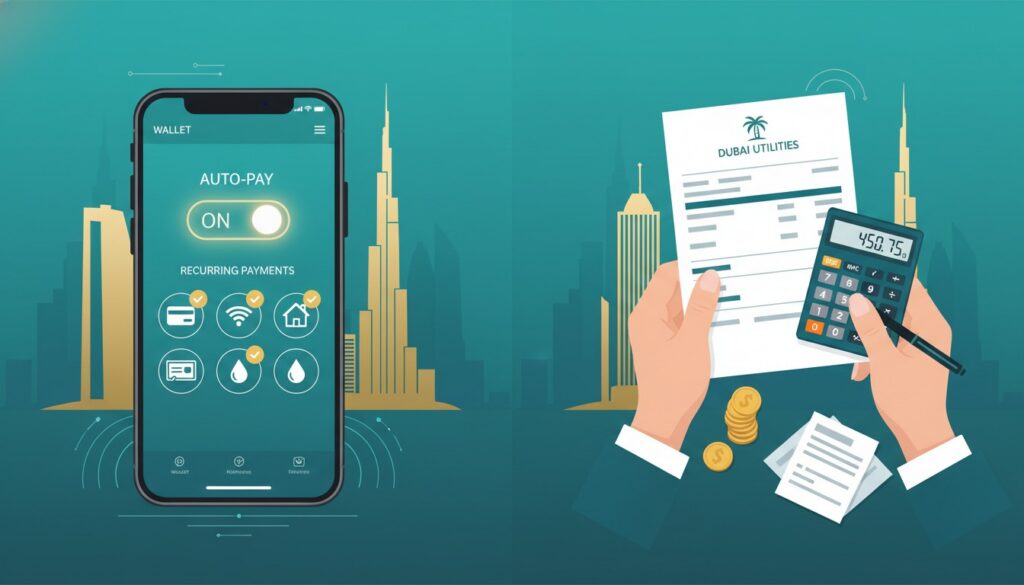
Auto-Pay vs. Manual Payment for Dubai Utilities: Pros, Cons, and Hidden Pitfalls
Introduction
Living in Dubai means juggling a handful of recurring utility bills — DEWA (Dubai Electricity and Water Authority), du or Etisalat for telecom, Emicool or other district cooling providers, and sometimes even community service charges. With so many payments to track, the temptation to “set it and forget it” with auto-pay is strong. But is convenience always king?
The truth is that both automatic and manual payment strategies come with trade-offs that most residents never consider until something goes wrong — an unexpected spike in a bill, a frozen bank account, or a missed due date that triggers a disconnection notice. In this comprehensive guide, we’ll walk through the real-world advantages, disadvantages, and hidden pitfalls of each approach so you can design a payment strategy that protects your wallet and your peace of mind.
Section 1: Understanding Your Dubai Utility Landscape
Before choosing a payment method, it helps to know exactly what you’re paying for and how billing works in the emirate.
Common Dubai Utility Bills
- DEWA — Electricity and water supply, including housing fees and sewerage charges.
- Telecommunications — du or Etisalat for internet, mobile, and TV bundles.
- District Cooling — Emicool, Empower, or Tabreed for air-conditioning in many apartment communities.
- Gas — ENOC or EMGAS for piped gas in select areas.
- Community/Service Charges — Managed by developers or owners’ associations (e.g., Emaar, Nakheel).
- Never miss a due date. Late DEWA payments can incur a 5% late fee on the outstanding amount, and repeated missed telecom payments can lead to service suspension. Auto-pay eliminates this risk entirely.
- Time savings. No queuing at DEWA customer happiness centres, no logging into multiple apps each month.
- Credit score protection. Consistent on-time payments build a positive AECB history, which matters when you apply for loans, credit cards, or even certain tenancy agreements.
- Cashback and reward points. Several UAE credit cards — including Emirates NBD, FAB, and Mashreq offerings — give reward points or cashback on recurring utility payments. Auto-pay ensures you capture these benefits every single month.
- Budgeting predictability. When bills leave your account automatically, your bank statement becomes a reliable spending log without manual data entry.
- Bill shock goes unnoticed. A water leak or malfunctioning AC unit can cause your DEWA bill to double or triple. With auto-pay, the inflated amount is debited before you even open the bill. By the time you notice, the money is gone and the dispute process begins.
- Insufficient funds and bank penalties. If your account balance is low when the debit hits, your bank may charge an AED 50–100 returned payment fee on top of the utility’s own late fee. This double penalty catches many residents off guard.
- Difficulty cancelling or pausing. Some banks require you to visit a branch in person or call a hotline to cancel a standing instruction. If you’re moving out of a property and forget to cancel, you could end up paying the next tenant’s bill.
- Security concerns. Linking your primary bank account or credit card to multiple billers increases your exposure if any platform suffers a data breach.
- Overlapping payments. If you manually pay a bill and the auto-debit fires on the same cycle, you may overpay. Getting a refund from DEWA or a telecom provider can take 2–6 weeks.
- Full visibility before every payment. You review the bill amount, compare it to previous months, and spot anomalies before money leaves your account.
- Flexibility with cash flow. If money is tight one week, you can prioritise which bill to pay first (as long as you stay within the grace period).
- Easier to manage during transitions. Moving apartments? Manual payment means there’s no lingering auto-debit to cancel or redirect.
- Multiple payment channels. Dubai offers a wealth of options: the DEWA app, Dubai Now super-app, bank apps, exchange houses, Carrefour kiosks, and even the Dubai Metro ticket machines for select services. You can pick the channel that offers the best reward or lowest fee at any given time.
- Human error and forgetfulness. Life in Dubai is busy. A forgotten DEWA bill can lead to a disconnection notice delivered within 10 days of the due date, and reconnection fees apply.
- Time-consuming. Managing four or five utility accounts manually each month adds up to hours over a year.
- Missed reward optimisation. Without a system, you might pay from a debit card when a specific credit card would have earned you 3% cashback.
- Late-night surcharges. Some third-party payment kiosks add a AED 2–3 convenience fee per transaction. Over 12 months across multiple bills, that’s a non-trivial sum.
- No automatic record. Unless you screenshot every confirmation, building a payment history for disputes or visa applications requires extra effort.
- Enable auto-pay for predictable, low-variance bills. Telecom bills and fixed-rate community charges rarely fluctuate. These are safe candidates for auto-debit.
- Keep variable bills on manual. DEWA and district cooling charges can swing significantly with seasonal usage. Pay these manually after reviewing the amount.
- Set up bill alerts. Both the DEWA app and most UAE banking apps allow SMS or push notifications when a new bill is generated. Turn these on for every account.
- Use a dedicated payments account. Open a secondary current account (many UAE banks offer zero-balance accounts) and fund it with just enough to cover auto-pay bills each month. This ring-fences your primary savings from unexpected debits.
- Review statements monthly. Spend 15 minutes at the end of each month comparing actual charges against your budget. Flag anything that deviates by more than 15%.
- Dubai Now App — Aggregates DEWA, Salik, telecom, and other government payments in one place.
- Bank Bill-Pay Dashboards — Emirates NBD’s LivePay, ADCB’s Hayyak, and FAB’s bill management tools let you view all linked billers at a glance.
- Spreadsheet or Budgeting App — A simple Google Sheet tracking bill amounts month-over-month can reveal trends and catch errors early.
- Auto-pay is ideal for fixed, predictable bills like telecom and community charges.
- Manual payment is safer for variable bills like DEWA and district cooling.
- Always enable bill alerts regardless of your chosen method.
- Use a dedicated account for auto-debits to protect your primary funds.
- Review every bill — even auto-paid ones — at least once a month.
How Billing Cycles Work
Most DEWA bills are generated monthly, with a payment window of roughly 15–30 days. Telecom providers typically bill on a fixed date each month. District cooling bills can be monthly or bi-monthly. Missing any of these deadlines can result in late fees, service disconnection, or negative marks on your credit bureau report — yes, the Al Etihad Credit Bureau (AECB) does track utility payment behaviour.
Pro Tip: Log into the DEWA app or website and note your exact billing cycle dates. Knowing when each bill drops is the first step to choosing the right payment method.
Section 2: The Case for Auto-Pay — Convenience With Caveats
Auto-pay (also called standing instructions or direct debit) lets your bank or credit card automatically settle a bill on or before its due date. Here’s why many Dubai residents love it — and why some have learned to be cautious.
Pros of Auto-Pay
Cons and Hidden Pitfalls of Auto-Pay
Real-World Example: A Dubai Marina resident set up auto-pay for DEWA and district cooling. During a two-month vacation, a concealed pipe leak ran up a DEWA bill of AED 4,200 — nearly ten times the usual amount. The auto-debit processed without any alert. It took six weeks and multiple DEWA visits to resolve the dispute and receive a partial credit.
Section 3: The Case for Manual Payment — Control at a Cost
Manual payment means you actively initiate each transaction — whether through the DEWA app, your bank’s bill-pay feature, Apple Pay at a kiosk, or even cash at an authorised payment centre.
Pros of Manual Payment
Cons and Hidden Pitfalls of Manual Payment
Pro Tip: If you choose manual payment, set calendar reminders three days before each due date. Better yet, batch all your utility payments on a single day each month — a “bill day” — so it becomes a habit rather than a chore.
Section 4: The Hybrid Approach — Best of Both Worlds
Many financially savvy Dubai residents use a hybrid strategy that combines the reliability of auto-pay with the oversight of manual review. Here’s how to set it up:
Step-by-Step Hybrid System
Recommended Tools
Section 5: Key Considerations for Specific Situations
If You’re a New Resident
Start with manual payments for the first three to six months. This lets you establish baseline amounts for each utility and understand seasonal variations (summer DEWA bills can be 40–60% higher due to air-conditioning load). Once you know what’s normal, selectively enable auto-pay.
If You Travel Frequently
Auto-pay is almost essential. A missed bill while you’re abroad can escalate quickly — DEWA disconnections happen, and reconnection requires an in-person visit. However, pair auto-pay with bill alerts so you can monitor remotely.
If You’re on a Tight Budget
Manual payment gives you maximum control. You can also take advantage of partial payment options — DEWA allows partial settlements, though the remaining balance must be cleared before the next billing cycle to avoid penalties.
If You’re Leaving Dubai
Cancel all auto-pay instructions at least two weeks before your final departure. Request final bills from DEWA and your telecom provider, settle them manually, and obtain clearance certificates. Failing to do so can result in debts that follow you to the AECB and complicate any future return to the UAE.
Conclusion
There’s no one-size-fits-all answer to the auto-pay vs. manual payment debate for Dubai utilities. Auto-pay excels at eliminating late fees and saving time, but it can mask billing errors and create cash-flow surprises. Manual payment offers granular control and financial awareness, but demands discipline and consistent attention.
For most residents, the sweet spot is a hybrid approach: automate the predictable, manually manage the variable, and layer on alerts and monthly reviews to catch anything that slips through. The few minutes you invest in setting up this system will pay dividends in avoided fees, optimised rewards, and genuine peace of mind.
Key Takeaways
Call-to-Action
Ready to take control of your Dubai utility payments? Start today by logging into your DEWA and telecom accounts, noting your billing dates, and deciding which bills deserve auto-pay and which need your personal review. If you found this guide helpful, share it with a friend or colleague who’s new to Dubai — they’ll thank you when they dodge their first billing surprise.
Have questions or a payment horror story of your own? Drop a comment below — we’d love to hear how you manage your utility payments in the UAE.
— Michael Brown